5 Pain Points in Takeaway Beverage Packaging: How to Choose the Right Paper Cup Without Problems
5 Pain Points in Takeaway Beverage Packaging: How to Choose the Right Paper Cup Without Problems
Takeaway drinks may seem simple, but packaging failures often begin with small details that are easy to overlook. A paper cup that leaks, feels too hot to hold, collects too much condensation, fits poorly with the lid, or fails to present brand graphics clearly can quickly affect product quality and customer experience. In beverage packaging, these problems are rarely isolated. They are usually caused by a mismatch between cup structure, coating, lid compatibility, and print performance. Choosing the right paper cup means evaluating the whole packaging system, not just selecting a size or comparing prices. That is why a reliable paper food container solution should be built around real beverage applications from the start.
Why Beverage Packaging Problems Happen So Often
Many beverage packaging issues begin when the cup is chosen only by appearance, basic specification, or unit cost. In practice, a cup that works well for iced tea may not perform well with hot coffee. A cup that looks sturdy before filling may soften after condensation forms. A lid that appears to match by diameter may still fail because the rim profile is slightly different.
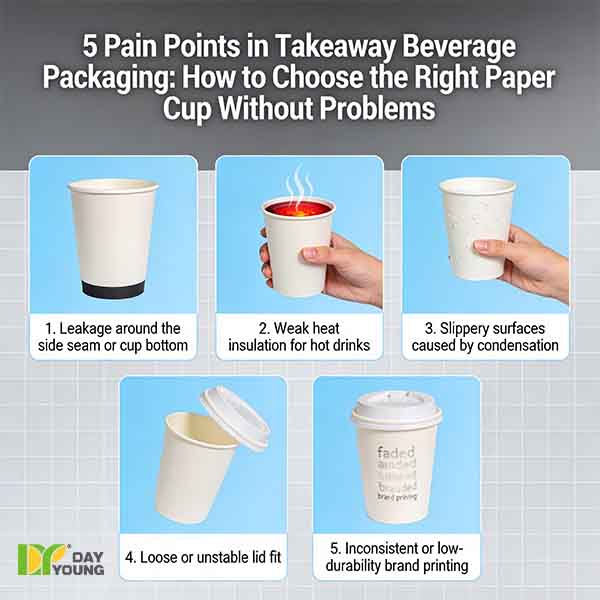
These problems usually appear in five areas:
- leakage around the side seam or cup bottom
- weak heat insulation for hot drinks
- slippery surfaces caused by condensation
- loose or unstable lid fit
- inconsistent or low-durability brand printing
A dependable paper food container manufacturer should help prevent these issues during development and testing, rather than leaving them to be discovered after launch.
The 5 Packaging Pain Points That Matter Most
Leakage Is Usually a Structural Issue
Leakage is one of the most common and most damaging packaging failures in takeaway beverages. It may come from weak side sealing, poor bottom bonding, or a coating that is not suitable for the beverage temperature or holding time. Hot drinks, acidic beverages, and extended delivery conditions all place more stress on cup construction.
For that reason, cup performance should not be judged by paper thickness alone. The cup’s seam integrity, bottom forming quality, and coating stability all affect leak resistance. If both hot and cold beverages are served, using the same cup specification for every drink may create unnecessary risk.
Heat Resistance Should Be Built Into the Cup
For hot beverages, comfort in the hand is just as important as liquid retention. A single wall cup may work well for warm drinks or for hot drinks when sleeves are added, but it may not provide enough insulation for higher-temperature coffee or tea. A double wall cup creates an extra layer of protection by forming an insulating air gap between the inner and outer walls.
This added insulation improves comfort, reduces the need for additional accessories, and helps create a more premium takeaway presentation. In many cases, better cup structure leads to better service flow as well.
Condensation Affects More Than Appearance
Cold drink packaging faces a different kind of challenge. When condensation forms on the outside of the cup, it can reduce grip, weaken handling comfort, and create a wet or unstable impression. This becomes especially noticeable in humid environments, with iced beverages, or during longer takeaway and delivery periods.
A well-designed cup for cold drinks should maintain stiffness and usability even when moisture builds up on the outer surface. This is not only about internal liquid resistance. External surface performance matters too.
Lid Compatibility Must Be Verified Carefully
A paper cup and its lid should always be evaluated as one packaging system. Even when nominal sizes match, actual fit may still be too loose or too tight. A loose lid increases the chance of spills during transport. A poorly matched lid may also deform the rim and weaken sealing consistency.
This is why testing matters. Sip lids, flat lids, and sealing film all create different performance requirements. Reliable lid compatibility depends on rim precision, dimensional consistency, and real-use trials rather than size labels alone.
Printing Quality Must Hold Up During Use
For many beverage products, cup printing is a major part of brand presentation. However, print quality is not only about color brightness or graphic design. If the print scratches, fades, or loses clarity after filling and handling, the cup no longer supports the intended brand image.
A strong print result depends on the relationship between substrate, coating, ink behavior, and production control. In other words, good branding on a paper food container starts with manufacturing quality, not just artwork.
Single Wall Or Double Wall Cups: Which Option Fits Better?
The choice between single wall and double wall paper cups should be based on beverage temperature, handling needs, and service style. The table below provides a practical comparison.
| Cup Type | Best Use | Main Advantage | Main Limitation |
| Single Wall Cup
|
Cold drinks, warm drinks, hot drinks with sleeves
|
Cost-effective and versatile
|
Less insulation for high-temperature drinks
|
| Double Wall Cup
|
Hot coffee, tea, premium hot beverages
|
Better heat protection and stronger tactile experience
|
Higher material cost
|
In many beverage applications, single wall cups remain a flexible and efficient option. Double wall cups are often the better choice when comfort, insulation, and a more premium presentation are priorities.
Coating Choice Also Changes Cup Performance
Cup coating is one of the most important but often underestimated factors in beverage packaging. It influences liquid resistance, heat tolerance, sealing behavior, and the broader sustainability direction of the product.
Common coating options include:
- PE coating for dependable hot and cold beverage applications
- PP coating for specific functional and packaging needs
- biodegradable or water-based coatings for projects with alternative eco-focused goals
The right coating should be selected based on beverage type, temperature, storage time, lid format, and market expectations. A coating should never be chosen by trend alone.
What Professional Manufacturing Adds to Beverage Packaging
At this stage, beverage packaging is no longer only about cup appearance or basic specifications. Long-term performance depends on manufacturing capability, including:
- stable cup forming
- reliable coating application
- accurate lid compatibility
- consistent print quality
- integrated production control
This is where Day Young brings added value. Since 1996, Day Young has focused on food packaging manufacturing in Taiwan, offering paper cups, plastic cups, paper food containers, and eco series products. With integrated in-house production, OEM and ODM support, and certifications such as ISO22000, HACCP, FDA, FSC, and PEFC, Day Young supports beverage packaging projects with greater consistency from development to delivery.
See Our Complete Product Catalog
Choosing a Cup That Prevents Problems Before They Start
When a takeaway beverage cup leaks, feels too hot, becomes slippery, does not seal well, or fails to present the brand clearly, the issue is usually not caused by one detail alone. It is the result of a packaging system that was not fully aligned with actual usage conditions. A better paper food container solution begins with matching structure, coating, lid format, and printing requirements to the beverage itself. For packaging projects that require stronger reliability and better brand presentation, contact Day Young to discuss the right direction for cup selection and custom development.
Share To: